
The warm-up exercises are among the most critical and least followed parts of any exercise schedule. Many injuries related to exercise have nothing to do with people having poor levels of fitness; instead, they are self-induced by either skipping or hurrying through the warm-up stage. A good, short warm-up prepares the body for physical activity by enhancing the quality of movement and significantly reducing the chances of sprains, strains, and joint injuries. The good news is that an effective warm-up does not need to be long. A focused five-minute warm-up can be enough to prepare the body for most workouts.
This article will explain why warm-ups matter, how to do a proper five-minute warm-up, and what exercises can help prevent workout injuries.
Why Warm-Up Exercises Are Essential
Warm-up exercises gradually prepare the body for physical activities. Blood circulation is increased to the muscles, the temperature of the body is elevated, and the joints are well lubricated to enable the smooth movement of muscles and connective tissues to ensure stress-free movement.
Failure to warm up before a workout may lead to stiff muscles and unprepared joints. As a result, one may develop muscle pulls, joint pain, and poor performance. In addition, a warm-up allows the mind and body to focus and coordinate perfectly.
What is a 5-minute warm-up Prevent Injuries
The warm-up exercise, which lasts only five minutes, is intended to activate major muscles, increase mobility, and improve movement patterns without resulting in fatigue. The aim is not to cause fatigue but rather to ready it.
- A well-structured warm-up
- Increases Muscle Elasticity
- It improves joint range of motion
- Activates stabilizing muscles
- Enhances neuromuscular
- Reduces Sudden Stress on Muscles & Joints
This enables the reduction of the risk of common workout injuries.
Principles of Effective Warm-Up
Preventing injuries A warm-up should be performed with the following key principles in mind:
- Go slow for a start, then gradually increase intensity
- Focus on dynamic movements instead of static stretches
- Target joints and muscles used in the workout
- Keep your breathing measured
- Keep movements pain-free
Following these principles makes the warm-up both safe and effective.
5-Minute Warm-Up Structure
A full five-minute warm-up can be broken up into three easy phases:
- Light cardio to increase heart rate
- Dynamic mobility exercises
- Muscle activation movements
Each phase plays a role in preparing the body for exercise.
Light Cardio (1-2 minutes):
Light cardio increases circulation and raises muscle temperature. This prepares the cardiovascular system for physical activity.
Marching in Place
Marching allows one to walk slowly, lifting the knees comfortably, with natural swinging of the arms to engage the upper body.
Benefits:
- Improves circulation
- Engages the legs and hips
It gently increases the heart rate.
Jumping jacks are low-impact
You can also do controlled jumping jacks or step from side to side to modify it to low impact.
Benefits:
- Engages full body
- Improves coordination
- Prepares muscles for movement
2. Dynamic Mobility Exercises: 2 minutes

Dynamic mobility exercises consist of actions that move the joints through specific ranges of motion. This enhances flexibility.
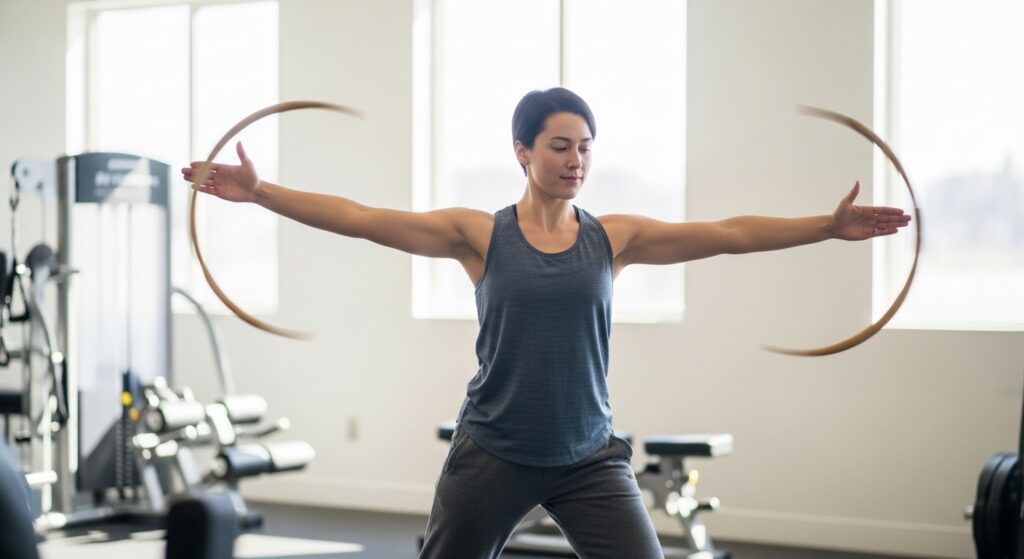
Arm Circles
Arms out to the sides: small circles increase in size.
Benefits:
- Warms shoulders
- Enhances the mobility of the upper body
- Reduces the risk of injury to the shoulders
Torso Rotations
Stand up and rotate your torso from side to side, keeping your hips stable.
Advantages:
- Engages the core muscles
- This improves the mobility of the spine
- Prepares the body for rotational movements
Hip Circles
Bring hands onto hips and circle them in slow motion.
Advantages:
- Loosens the hip joints
- Improves lower-limb mobility
- Reduces the strain on the knees and the back
3. Muscle Activation Exercises (1-2 minutes)
Firstly, muscle activation exercises focus on those muscles that facilitate the stability of body parts. The muscles are activated to ensure they are always ready for use during exercise.
Bodyweight Squats
Practice squats while maintaining good posture, i.e., lift your chest and keep your knees in line.
Benefits:
- Activates Legs & Glutes
- Prepares knees and hips
- Improves movement mechanics
Lunges/Steps
Step back into a lunge position and stand up again.
Benefits:
- Activates lower body muscles
- Improves Balance
- Reduces forward knee stress
Push-ups (Modified if Needed)
Do push-ups, either on the floor or against a wall.
Benefits:
- Activates Chest, Shoulders, and Arms
- Prepares upper body for push actions
- Improves joint stability
Adaptation of Warm-Up to Varying Exercises
A five-minute warm-up may be adapted in accordance with the specific workout.
For Strength Training
Pay more attention to muscles that are activated in relation to the exercises used.
For Cardio Workouts
Adding slightly more light cardio and dynamical exercises to increase heart rate slightly more.
For Home Workouts
Choose bodyweight movements that require little space and no special equipment.
Common Warm-Up Mistakes to Avoid
Common mistakes should be avoided for the warm-up to be effective.
Common mistakes include:
- Skipping the warm-up altogether
- Static stretches prior to exercise
- Moving too fast without control
- Ignoring tight or weak spots
- Turning a warm-up into a full workout
The warm-up must prepare the body, not exhaust it.
Role of Breathing in Warm-Up Exercises
Adequate breathing can also help to regulate the heart rate. The breathing should be normal and consistent during the warm-up.
Holding one’s breath adds tension and compromises movement efficiency. Controlled breathing is beneficial to effective muscle activation and focus.
Warm-Up Safety Tips
Safety is also important, particularly for beginners.
Important tips include:
- Start with low intensity
- Avoid movements that cause pain
- Maintain proper posture
- Adjust exercises according to your fitness level
Adjust movements according to existing injuries where necessary.
Benefits Beyond Injury Prevention
Warm-ups provide other benefits besides injury prevention.
Other benefits include
- Improved workout performance
- Better range of motion
- Improved muscle coordination
- Increased Mental Readiness
A consistent warm-up regime is helpful for making fitness progress.
Who Should Do a 5-Minute Warm-Up
A five-minute warm-up is applicable for:
- Beginners
- Experienced athletes
- Home Workout Enthusiasts
- Persons who have tight muscles or stiff joints
It can also be taken before any exercise.
Making Warm-Ups a Habit
Consistency is key, and making warm-ups non-negotiable aspects of a person’s exercise routine can help increase their efficacy.
Clearing a space of time before every exercise session can help establish a routine, which is essential for the development of a healthy lifestyle. Setting aside just five minutes can go.
Conclusion
A five-minute warm-up exercise technique is one of the powerful tools in preventing injuries and harm during workouts. Warm-up exercises allow increased blood circulation and flexibility and muscle activation, making it easier to move and perform physical tasks without straining muscles and other body parts.
Whether you’re in good shape or not, or whether you do aerobic exercise or not, taking five minutes to warm up benefits performance, injury prevention, and overall physical well-being in the long run. Making warm-up exercises a habit in the gym is one of the smartest decisions to avoid injury during workouts.
1 thought on “Best 5 Minute Warm Up Exercises for Injury”